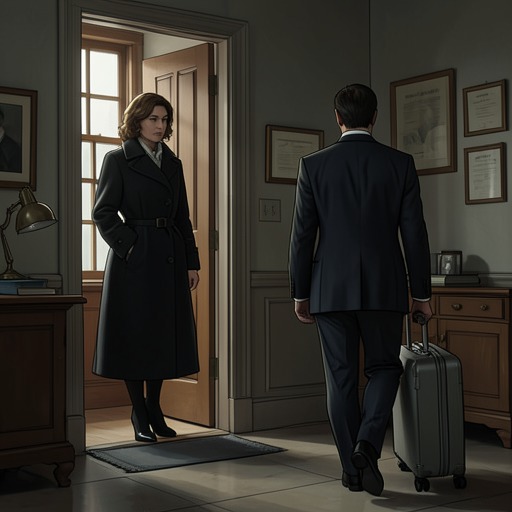
Gayle Stryker murders and dismembers an unidentified girl and frames Erik
Day of the DeadGayle Stryker’s murder of an unidentified girl and her attempt to frame Erik LaGrange turn a private act of violence into a planned public deception. The crime depends not only on Gayle’s decision to kill, but on the network that has brought girls within her reach, Larry Stryker’s complicity in concealing what happened, and her effort to redirect suspicion toward an ex-lover. The girl’s identity is not established in the account of the killing; a later fingerprint match connects the remains to an earlier case involving an unidentified young female victim.
Background and Access
The girl’s vulnerability belongs to a larger pattern of institutional exposure. Maria Elena Dominguez’s history provides a concrete example of the dangers facing girls moved among facilities: after running away from an orphanage and then a juvenile detention center, she and two other girls were transported under guard to El Asilo Seguro outside Hermosillo. Although its name meant Safe Haven, boys and girls were housed together with weak supervision, and the institution failed to make its residents safe. The account does not establish that Maria Elena was the unidentified victim in this event, but it shows the conditions in which girls could be transferred, isolated, and placed at risk.
Medicos for Mexico helped make such access repeatable. Gayle used the cross-border charity to gain money, community standing, and a respectable public identity; through it, girls from detention centers served by the organization could be brought into the Strykers’ orbit. The charity also gave Gayle a means of controlling Larry. She could decide when a girl was brought into the basement and when she was removed, leaving Larry dependent on her for the next opportunity. This system did not erase the responsibility of the people who exploited it: it supplied access and concealment, while Gayle and Larry chose how to use them.
The organization also enriched the couple. Donations entered accounts with little outside oversight, and vague expense entries helped fund their lifestyle. Gayle and Larry received salaries, while money from the charity also supported a nearly finished mansion in a gated compound outside Cabo San Lucas. Respectability and private criminality therefore operated together: the organization’s public purpose helped shield a private arrangement built around vulnerable girls.
The Killing and Concealment
The murder’s aftermath emerges through two linked scenes. When Larry goes to the basement carrying a plate of food, he recognizes that something has changed before he descends. The room is empty, and he understands from the signs that Gayle has left a new catastrophe for him to find. She has previously removed girls without warning, often leaving Larry to deal with the aftermath; on this occasion, the violence is on a different scale. He abandons the food and goes to retrieve a power washer to remove blood from the basement’s concrete surfaces.
The eventual roadside discovery makes the crime visible to investigators. At the scene, technicians cast tire tracks and photograph black plastic bags containing the remains of a young female. The remains show that the victim had been dismembered; the body also bears signs of earlier abuse. The discovery establishes that the girl was murdered and that someone tried to dispose of her remains away from the place where she had been killed. It does not, by itself, identify the killer or the victim.
Larry’s role in cleanup is part of the crime’s concealment, not an act separate from it. His familiarity with Gayle’s pattern helps him understand what has happened, and he proceeds to remove the blood from the basement. The arrangement between them is unequal in its immediate operation: Larry has control over the girls while they are in the basement, but Gayle retains the power to take them away and determine when replacements arrive. Their shared secrecy makes that control possible and leaves the victim without a reliable protector inside the house.
The Frame-Up of Erik LaGrange
Gayle’s plan to implicate Erik grows out of her anger at being discarded. When Larry recognizes that she intends to set Erik up, she confirms the plan and explains that Erik had thought he could throw her away. Her motive is personal retaliation, but the accusation she prepares is a murder charge, giving the break-up a potentially fatal consequence for the man she means to punish.
She recruits Larry to support the deception. Gayle anticipates that Erik will mention their affair and claim that she was with him the previous night; she intends to concede that they met and argued, then use Larry to corroborate a different account of where she spent the night and the following morning. The sequence converts genuine elements of her relationship with Erik into parts of a false alibi. Larry’s agreement would give the story a second participant and make the two men serve opposite functions: Erik as the accused, Larry as Gayle’s supporting witness.
The frame-up also exposes the instability in Gayle’s plan. Later, she recognizes that acting under the pressure of her emotions has created new problems and that the accusation no longer seems as sound as it had the night before. She considers emptying the Medicos accounts and moving the money to Mexico or the Cayman Islands. In that calculation, Larry becomes expendable too. Her intended escape would leave behind both the man she has framed and the accomplice who helped her conceal the murder.
Investigation and Significance
The body’s discovery initially leaves the victim unidentified. A later AFIS inquiry reveals that a single fingerprint from the inside of a garbage bag containing dismembered remains matches a case from three years earlier: an unidentified female, estimated to be thirteen to fifteen, found near a rest area along Interstate 8 beyond Gila Bend. The match expands the meaning of the roadside evidence, linking the current inquiry to an earlier death without, in this account, supplying the victim’s name.
The case also sits within a wider failure to protect and investigate Native victims. In Brandon Walker’s recollection of Roseanne Orozco’s murder, jurisdiction and resources shaped what investigators did: suspected murders on Native lands fell to federal or tribal authorities, while the Papago Tribal Police Force lacked training, equipment, and money. That context helps distinguish the crime itself from the conditions that can leave it unresolved. Institutions that failed to supervise vulnerable girls, and investigative systems that neglected Native homicides, created openings and delays; neither circumstance transfers responsibility away from Gayle or Larry.
The event therefore joins three forms of control: Gayle’s power to select and remove girls, Larry’s physical control over those held in the basement, and Gayle’s attempt to control the investigation by manufacturing an alibi and choosing a scapegoat. The roadside remains interrupt that arrangement. Their discovery turns concealed violence into a case that can be connected by physical evidence, while the fingerprint match suggests that the murder belongs to a pattern larger than one body and one attempted frame-up.